


Prepare the system, not just the discount
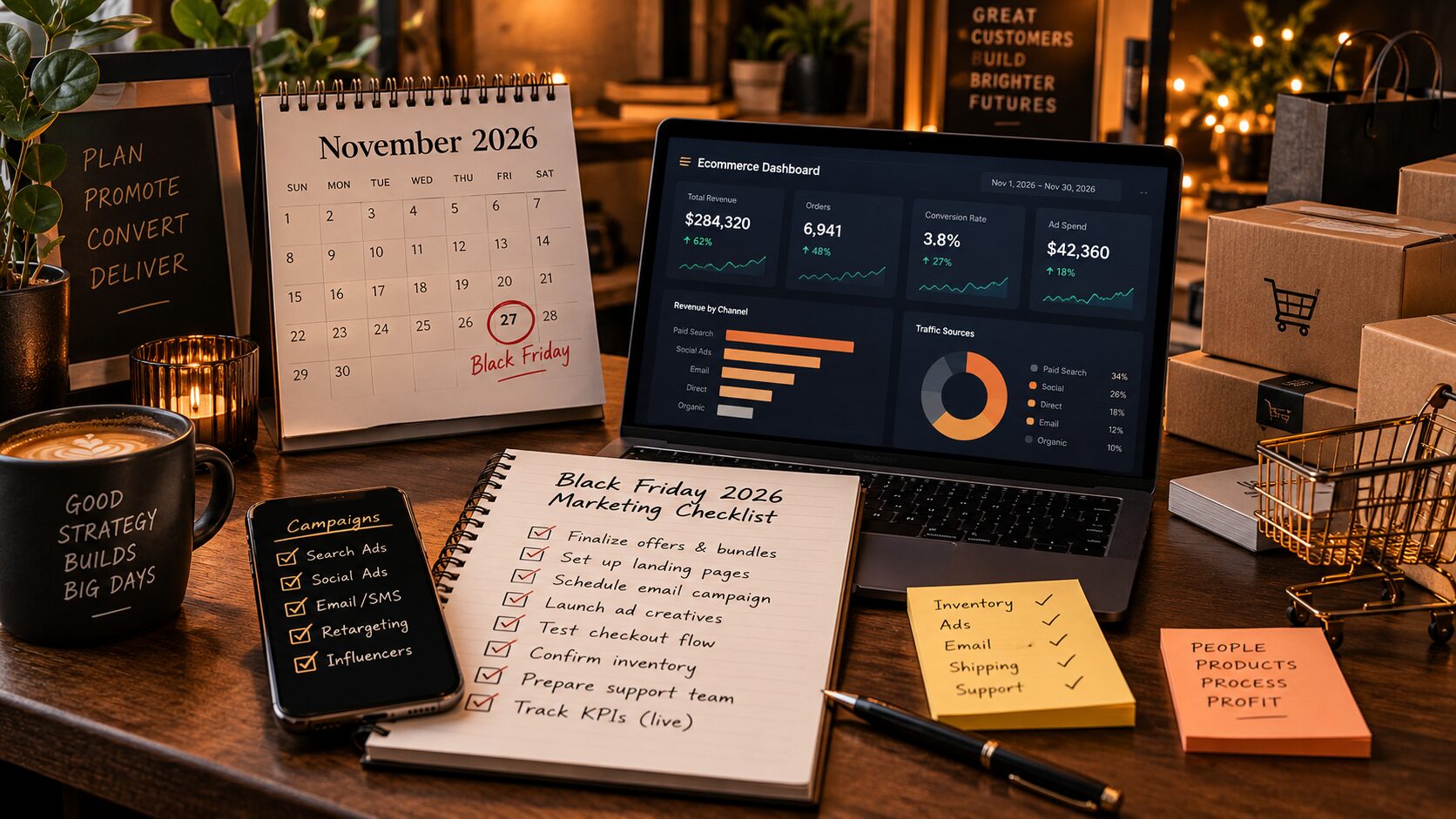
Black Friday 2026 falls on Friday, November 27. The shopping rush is an opportunity to acquire customers, increase inventory turnover and learn which offers resonate. It is also a period when advertising costs can rise, stockouts can damage trust and aggressive discounts can turn revenue growth into disappointing profit. A campaign plan therefore needs to cover operations, finance, analytics and customer service, not merely social ads and email subject lines.
The following checklist is designed for small and mid-sized ecommerce teams. Adapt the details to your average order value, replenishment model and fulfillment capacity. A retailer selling made-to-order products will have different constraints from a business selling downloadable software, but both need accurate economics and a reliable purchase journey.
1. Define commercial goals and guardrails
Specify the target outcomes: net revenue, contribution profit, new customers, inventory clearance or repeat purchases. These objectives can conflict. A discount that maximizes revenue might not maximize profit. Agree on minimum acceptable margin, acquisition payback and spend limits before promotional pressure begins. Use scenario plans for conservative, expected and upside demand rather than assuming last year’s growth will repeat.
Connect the target to daily operating decisions. If the campaign is ahead on traffic but behind on profit, the team should know whether to reduce discounts, adjust product mix or refine acquisition spend. Avoid last-minute debates about which KPI matters by putting commercial guardrails in writing.
2. Audit products, stock and fulfillment
Identify hero products, bundles, high-margin items and inventory at risk of sitting unsold. Review stock availability, inbound deliveries and replenishment lead times. Coordinate advertising with inventory realities: an ad promoting a sold-out product wastes demand and creates frustration. Where product feeds are involved, check availability fields and pricing updates.
Estimate maximum daily order-handling capacity. Can the warehouse pack twice the usual volume? Do customer support and delivery partners have contingency plans? Paid media can create demand faster than operations can fulfill it, so realistic volume forecasts should inform the budget.
3. Build offers from unit economics
Calculate product-level contribution after cost of goods, payment fees, fulfillment, expected returns and the proposed discount. A 30% promotion is not automatically better than a 15% offer combined with a relevant bundle. Test free-shipping thresholds against average basket value and shipping economics. Be transparent about genuine savings and ensure promotional claims comply with applicable consumer pricing rules.
Create a simple approval table for every promoted SKU: normal price, campaign price, inventory, contribution per order and allowable acquisition cost. That protects the team from attractive-looking revenue numbers masking losses.
4. Segment customer communication
New visitors, recent buyers, lapsed customers and VIP shoppers should not all receive identical messages. Existing customers may value early access, a useful bundle or reliable delivery more than the deepest possible discount. New prospects may need stronger social proof and product education. Plan a sequence of pre-launch interest, launch announcement, reminder and last-chance communication without overwhelming subscribers.
Respect consent and frequency controls. A promotional event is not a reason to abandon email deliverability principles or send repeated messages to people who did not agree to receive them.
5. Prepare paid media and creative
Develop creative before the final week. Produce distinct concepts for offer value, product benefits, gifting and scarcity only where scarcity claims are truthful. Check campaign structure, conversion goals and product feeds. Avoid making numerous major settings changes on launch day. Set budget scenarios and clear escalation rules rather than forcing automated systems through constant manual reactions.
Separate creative-testing budgets from proven campaign spend where useful. If the goal is acquiring new customers, monitor new-customer quality and contribution, not merely platform-reported sales. Creative that attracts discount hunters may outperform on clicks while delivering weaker long-term value.
6. Stress-test the website and checkout
Review mobile load experience, navigation, search, product availability, discounts, tax and shipping calculations, and payment methods. Test the full funnel with real devices and browsers. Confirm that voucher combinations behave as intended and that delivery promises are achievable. Prepare a basic rollback plan for a broken promotion or checkout release.
Even excellent campaigns fail when purchase friction rises. Prioritize resolving critical checkout problems before cosmetic landing-page improvements. A five-minute end-to-end purchase test can surface more risk than an additional week of ad-copy polishing.
7. Validate analytics and conversion tracking
Ensure purchase events fire once, order values are accurate, refunds are treated consistently and the reporting system distinguishes new customers where possible. Validate UTM naming and channel cost data. Compare test orders between the commerce platform, analytics and ad platforms; expect attribution differences, but investigate missing events or duplicate purchases.
Create a campaign dashboard in advance. Track net sales, spend, MER, conversion rate, average order value, CAC, contribution profit, stock position and customer-service issues. Know which figures refresh immediately and which have delays.
8. Schedule email, SMS and onsite messages
Build and proofread assets, define send windows and check local times for international audiences. Use clear subject lines instead of misleading urgency. Prepare onsite banners and promotional landing pages with matching messages. If sending SMS, verify opt-in permissions and regional requirements.
Create an exception workflow: who can pause a broken campaign, stop an email, adjust the offer or update a stock message? The more channels involved, the more important one shared source of truth becomes.
9. Organize live monitoring and customer support
Assign responsibilities for paid media, ecommerce operations, analytics, fulfillment and support. Establish a short daily check-in during peak trading. Watch early warning signs such as payment errors, inventory mismatches, delayed dispatches, rising refund requests and sudden tracking gaps. Document decisions so the team can understand what changed.
Prepare customer support templates for delivery timing, returns and discounts. Fast, honest communication often protects long-term customer value better than an aggressive attempt to save every single sale.
10. Plan the post-event follow-up
Black Friday does not end when the promotion closes. Review the new-customer cohorts: what did they buy, how much margin did the business retain and how many returned? Compare marketing spend with net revenue and incremental evidence where available. Document winning creative concepts, operational issues and the value of specific offers.
Follow-up communication should be useful. Product care instructions, onboarding, replenishment or relevant recommendations can improve retention. Avoid using every new customer as a reason to launch an immediate barrage of unrelated promotions.
A four-week countdown
Four weeks before launch, finalize commercial targets, product selection and ownership. Three weeks out, audit stock, technology, tracking and creative. Two weeks out, complete landing pages, email flows and support preparation. In the final week, run end-to-end tests and freeze unnecessary changes. During launch, monitor operational risk and business outcomes, then conduct a retrospective within a few days.
The strongest promotional campaign is not always the one reporting the highest revenue on Friday. It is the one that delivers sustainable contribution, reliable service and customers with a reason to return after the sale.
FAQ
When is Black Friday 2026? November 27. Should every product be discounted? No; use product-level economics. What matters beyond ROAS? Net revenue, contribution, new-customer CAC and fulfillment quality. Should budgets increase automatically? Only within pre-agreed financial and operational guardrails.