


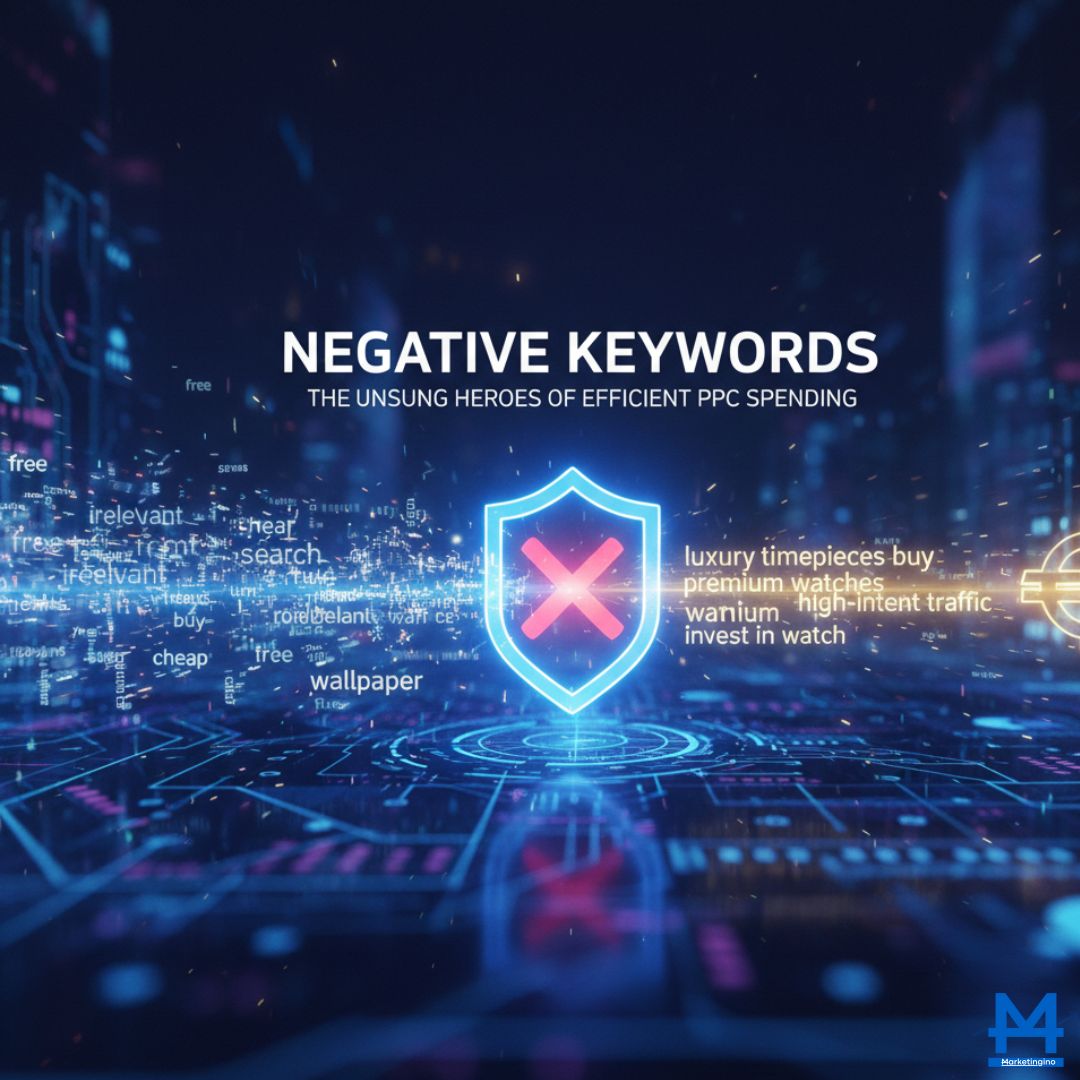
In the complex world of Pay-Per-Click (PPC) advertising, the spotlight often falls on the “positive” keywords—the phrases that trigger your ads and bring in potential customers. Yet, there is a quiet, powerful force working behind the scenes to safeguard your budget and boost your return on investment (ROI): negative keywords.
These unassuming terms are the unsung heroes of efficient PPC spending. By proactively excluding them from your campaigns, you prevent your ads from showing up for irrelevant searches, ensuring every dollar you spend is targeting high-intent users.
What Exactly Are Negative Keywords?
Simply put, a negative keyword is a word or phrase that you explicitly tell the advertising platform (like Google Ads or Microsoft Advertising) to not show your ad for. They act as a sophisticated filter, blocking your advertisement from appearing in search results that are unlikely to lead to a sale or conversion.
Imagine you sell premium, high-end watches. You might bid on a broad keyword like “luxury timepieces.” However, without negative keywords, your ad could be triggered by low-intent or irrelevant searches such as:
- “free luxury timepieces”
- “how to repair luxury timepieces”
- “cheap luxury timepieces”
- “luxury timepieces wallpaper”
Each irrelevant click costs you money, quickly draining your budget without any chance of a return. By adding “free,” “repair,” “cheap,” and “wallpaper” as negative keywords, you immediately cut that waste.
The Positive Impact of a Negative Strategy
The strategic use of negative keywords yields a host of benefits that directly impact your campaign’s profitability:
- Reduced Wasted Ad Spend: This is the most direct and crucial benefit. By eliminating clicks from uninterested searchers, you save money that can be reallocated to search queries with a much higher probability of conversion.
- Higher Click-Through Rate (CTR): When your ads are shown to a more relevant audience, more people will click on them. A higher CTR is a key factor in improving your Quality Score.
- Improved Quality Score (QS): Relevance is king in PPC. Negative keywords drastically improve your ad’s relevance to the user’s search intent. A better Quality Score means you pay less per click (Lower CPC) and achieve higher ad rankings.
- Enhanced Ad and Campaign Targeting: Negative keywords allow you to laser-focus your targeting. For example, if you sell dog collars, you can use negatives to prevent your ad from showing up for people searching for “cat collars,” ensuring your ad groups remain tightly themed and effective.
- Boosted Conversion Rates: By only attracting genuinely interested prospects, your website traffic will be of a higher quality, resulting in more conversions and a higher overall ROI.
How to Find Your Campaign’s Negative Keywords
Identifying the right negative keywords is an ongoing process that requires both proactive foresight and reactive analysis:
- Initial Brainstorming: Before a campaign even launches, think like an irrelevant searcher. Common categories to consider include:
- Low-Intent Terms: free, cheap, torrent, download, job, salary.
- Irrelevant Product Types: If you sell ‘coffee tables,’ negate ‘end tables,’ ‘dining tables,’ etc.
- Research Terms: how to, tutorial, definition, review (unless you want to target the research phase).
- Competitor Names: If you have separate campaigns, ensure one campaign’s ad group isn’t bidding on another’s terms (this is a more advanced strategy).
- Analyze Search Term Reports: Once your campaigns are running, regularly review the Search Term Report (found in Google Ads) to see the actual queries that triggered your ads. Look for terms with high impressions but zero clicks, or worse, high clicks but zero conversions. These are your prime candidates for the negative list.
- Leverage Match Types: Just like positive keywords, negative keywords have match types (Broad, Phrase, and Exact) that determine how strictly the term is blocked. Use a negative Phrase Match for common phrases and a negative Broad Match for widely irrelevant, single-word terms.
A Continuous Process, Not a One-Time Fix
Treating negative keywords as a set-it-and-forget-it task is a costly mistake. The digital landscape—and user search behavior—is constantly evolving. A highly efficient PPC strategy involves a regular, dedicated review of your Search Term Reports and a continuous refinement of your negative keyword lists.
By taking the time to manage and update your negative keywords, you move beyond simply attracting clicks and focus on attracting profitable traffic. The unsung heroes of negative keywords are truly the cornerstone of a lean, high-performing PPC campaign.